
George Washington Trail
The Revolutionary Beginning
Washington, a Virginia planter and experienced military officer who had served in the French and Indian War, accepted the command with characteristic gravity. He immediately set out from Philadelphia for Boston to take command of the army that was already engaged in battle around the city. This journey would take him through multiple states, including Connecticut, which would become a crucial supply route and battleground throughout the Revolutionary War.
The 1775 Journey North
Washington’s northbound journey in summer 1775 was more than a simple military maneuver—it was a symbolic moment for the young nation. As he traveled through Connecticut, he passed through communities that would play vital roles in the Revolutionary cause. The journey from Philadelphia to Boston typically took two to three weeks by coach, following established post roads that connected colonial towns.
Connecticut’s strategic importance during the Revolution cannot be overstated. The state became known as the “Provisions State” because of its crucial role in supplying the Continental Army with food, munitions, and supplies. Towns along Washington’s route, including Durham where this marker stands, contributed significantly to the war effort.
The Return in 1789
Fourteen years later, in 1789, Washington traveled this same route again, but under vastly different circumstances. This time, he was journeying to New York City to be inaugurated as the first President of the United States. After the British surrender at Yorktown in October 1781, the war had ended, and the nation had established its independence. Washington’s 1789 journey was a triumphal procession, with communities turning out to celebrate the hero of the Revolution.
Marking History
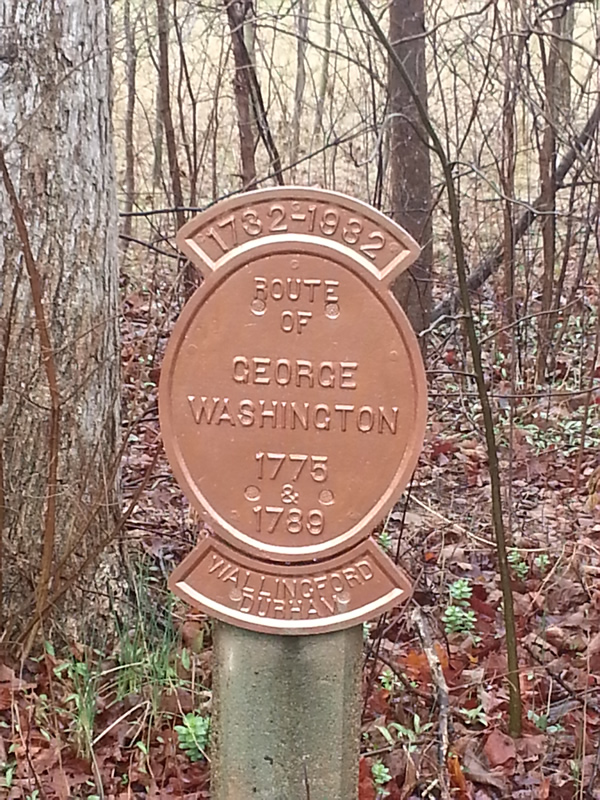
The plaque photographed here in Durham commemorates Washington’s historic journeys through Connecticut. It was placed in 1932 as part of the bicentennial celebration of Washington’s birth (1732-1932). These markers can be found throughout Connecticut and other states along what became known as the “Washington Trail,” reminding us of the paths our nation’s founders traveled to create the United States.
Today, many of these historic routes still exist, often incorporated into modern roads. The road passing through Durham that Washington traveled in 1775 and 1789 is much the same as it was over 240 years ago. While no longer traveled by horse-drawn coaches or military columns, it continues to connect Connecticut’s communities, serving as a tangible link to our nation’s founding era.
Connecticut’s Revolutionary Legacy
Connecticut played a vital and often underappreciated role in the American Revolution. Beyond supplying the Continental Army with food and materials, the state’s citizens fought in nearly every major battle of the war. The state’s Long Island Sound ports became centers of privateering activities against British merchant ships. Yale College (now Yale University) contributed many officers to the Continental cause. And towns throughout the state served as way stations for the movement of troops, supplies, and important persons like Washington himself.
Standing before this marker in Durham is a powerful reminder of Connecticut’s role in American history and the momentous journey that George Washington undertook to lead a new nation to independence and establish a republic that endures to this day.