
Nathan Hale: Connecticut's State Hero
A Connecticut Patriot’s Sacrifice
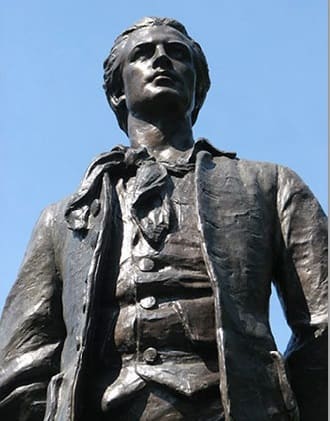
On September 22, 1776, a 21-year-old schoolteacher from Coventry, Connecticut, faced the gallows with quiet courage. Nathan Hale was hanged by the British for spying against them during the American Revolutionary War. His death would become one of the most inspiring martyrdoms of the Revolution, and over two centuries later, in 1985, the Connecticut legislature officially designated Nathan Hale as Connecticut’s state hero.
From Schoolmaster to Soldier
Nathan Hale was born on June 6, 1755, in Coventry, Connecticut, to a deeply religious family with a long tradition of service. He attended Yale University, where he graduated in 1773. Rather than immediately pursuing a military career, Hale became a schoolteacher, first teaching in East Haddam and later in New London. These were formative years for the young educator, who developed a reputation for both dedication to his students and patriotic conviction.
When the American Revolution began in the spring of 1775, Hale joined a Connecticut militia unit and within five months was elected first lieutenant. His friend Benjamin Tallmadge sent him an inspiring letter to convince him to leave his teaching position and join the Continental Army, and Hale accepted a commission in the 7th Connecticut Regiment. He participated in the siege of Boston and was promoted to captain in 1776.
By mid-1776, Hale was serving with William Heath’s brigade in New York, where he participated in military operations including the capture of a British provision sloop—a daring feat accomplished from under the guns of a British man-of-war. But it was a more dangerous assignment that would define his legacy.
The Intelligence Mission
Desperate for information about British forces occupying New York, General George Washington called for a volunteer to undertake a dangerous spying mission. Hale left New York and traveled to Norwalk, Connecticut, where he arranged passage across Long Island Sound. He left his uniform, commission, and official papers behind in Norwalk, and dressed as a schoolmaster in a plain brown suit and a round hat, landed in Huntington, Long Island.
He should have made a convincing schoolmaster since he taught school for two years before joining the army, but he asked too many questions and soon aroused suspicion. In conversation with a British agent posing as an American sympathizer, he revealed his mission and British authorities promptly arrested him. On September 21, 1776, while attempting to return to his regiment after penetrating British lines on Long Island, Hale was captured.
The Final Day
On the morning of September 22, Hale was marched to his execution. He was hanged without trial, a stark reminder of the brutality of war. According to historical accounts, he met his death with remarkable composure. A British officer named Frederick MacKensie wrote in his diary on that day: “He behaved with great composure and resolution, saying he thought it the duty of every good Officer, to obey any orders given him by his Commander-in-Chief; and desired the Spectators to be at all times prepared to meet death in whatever shape it might appear.”
The Myth and the Reality
Over the years, Hale’s memory became the subject of legend. Many accounts claim his last words were, “I only regret that I have but one life to give for my country.” The words are from Joseph Addison’s play Cato, and though the play was a favorite of Hale and his friends when at Yale, there is no reason to think that Hale spoke them at his execution.
It was one of his college friends who attributed to him his famous last words, immortalizing Hale in a way that resonated with the American spirit. Whether or not he spoke these exact words, his actions spoke louder than any words could have. Hale is regarded by American Revolutionary tradition as a hero and martyr, his sacrifice transcending the specifics of history to become a symbol of patriotic duty.
A Hero’s Legacy
Hale’s body was never recovered, and he became known as a martyr to the cause of American independence. Hale was not a very good spy, but he was a patriotic and likeable young man with many good friends who, over the years, kept his memory alive.
Today, statues of Nathan Hale stand in multiple locations across the United States, including at Yale University, in Hartford’s Connecticut State Capitol, and in Washington, D.C. Each September 22, Connecticut remembers the young teacher who gave everything for his country. His sacrifice reminds us that the price of freedom is sometimes paid by ordinary people willing to do extraordinary things.
Connecticut’s Revolutionary Spirit
Nathan Hale embodied the revolutionary spirit that Connecticut itself demonstrated throughout the war. Like George Washington’s journeys through the state, Hale’s story is woven into the fabric of Connecticut’s crucial role in American independence. From Coventry’s quiet towns to the battlefields and spy networks of New York, the young patriot proved that courage knows no age, and that one person’s determination to serve can inspire a nation.
As we mark September 22 each year, we honor not just Nathan Hale, but all those who risked and lost everything in the fight for American freedom. Connecticut’s state hero remains a beacon of patriotism and selfless dedication to the cause of liberty.