
Thomas Hooker: Connecticut's Founding Father
A Statue in Old State House Square
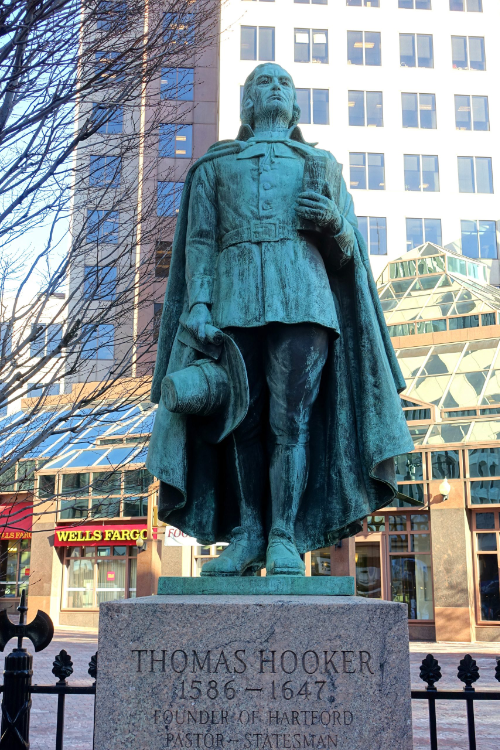
On October 20, 1950, several hundred people gathered in front of the Old State House in Hartford to watch the unveiling of a new eight-foot statue of Thomas Hooker. The Puritan minister is remembered as the founder of Hartford and one of the founding figures of Connecticut. More than three centuries after his death, his name still stands at the center of the state’s story.
From England to Holland to Boston
Thomas Hooker was born in July 1586 in Marfield, Leicestershire, England. He studied at Emmanuel College, Cambridge, and went on to serve as a minister in England. His preaching drew the attention of church authorities. In 1629, Archbishop William Laud suppressed church lecturers, and Hooker was forced out of his post. He eventually fled to the Netherlands, where he spent several years before returning to the Puritan colonies.
Hooker arrived in Boston in September 1633, aboard the Griffin. He became the first pastor of Newtown, a settlement across the Charles River that later became Cambridge, Massachusetts.
Leading the Way to the Connecticut Valley
By the mid-1630s, members of the Newtown church were unhappy with the amount of land available for farming. Hooker led a company of roughly one hundred men, women, and children westward along an old Native American trail, later called the Connecticut Path or the Bay Path, to the Connecticut River. Hooker, who was in poor health, traveled part of the way on a horse litter.
The group established a settlement on the river in 1636. It was first called Newtown and was soon renamed Hartford, after the English hometown of minister Samuel Stone. Hooker served as its pastor until his death.
The land was not empty. The Saukiog chief Sequassen sold the English the land that became Hartford and West Hartford. The founding of Hartford was part of a larger colonial story that also changed the lives of the Native peoples of the region.
The Fundamental Orders
Hooker’s most lasting legacy is the Fundamental Orders of Connecticut. In 1638, representatives from the river towns of Hartford, Wethersfield, and Windsor met to create a framework for a new government. The Orders were ratified on January 14, 1639.
The document is often called the first written constitution in America, and some describe it as the world’s first written democratic constitution that created a government. Historians debate exactly how much Hooker wrote himself. But his sermons and political ideas are widely seen as a major influence on the document. He argued that government authority came from the consent of the people, and he defended the idea that those who govern should be chosen by the governed.
The Fundamental Orders served as the legal basis for the Connecticut Colony until Charles II granted it a formal charter in 1662.
A Man of Conviction
Hooker’s ideas did not always win him friends. He disagreed with restrictive rules about who could vote and hold office, which put him at odds with some powerful ministers in Massachusetts. Those disagreements were part of what led to the move to the Connecticut Valley, where the settlers could govern themselves.
Hooker died in Hartford on July 7, 1647, at age 61. He is remembered as a leader who combined deep religious conviction with a belief that ordinary people deserved a voice in their government.
Remembering the Founder Today
Replicas of the 1636 church and house built by Hooker were constructed on the state capitol grounds for the Connecticut Tercentenary in 1935, a reminder of how much the state has long honored its founder. Today his statue in Old State House Square invites visitors to stop and consider the start of Connecticut’s long tradition of self-government.
As Connecticut marks the 250th anniversary of American independence this year, Hooker’s story is a useful reminder that the state’s commitment to self-rule began more than a century before the Revolution.